Showing posts with label modern classical. Show all posts

Sunday, October 30, 2011

Max Richter - Waltz with Bashir OST


2009; 20 tracks


The soundtrack to Ari Folman's groundbreaking animated documentary Waltz with Bashir. In one of
Max Richter's most rich and stunning scores, you will be sure to find an incredible array of simplicity, passion, and longing. Among the originally composed pieces is "Enola Gay" by O.M.D. (Ochestral Manoeuvres in the Dark) and "This Is Not a Love Song" by P.I.L. (Public Image Ltd.) My favorite track is definitely "Haunted Ocean," a single image with 5 variations.

Memory takes us where we need to go.

Sunday, October 23, 2011

Rachel Grimes - Book of Leaves


2009; 14 tracks


Rachel Grimes is the pianist for the group Rachel's, whose album I posted a few days ago. This is her only solo album, but it is an entirely gorgeous and entrancing work. If you listened to the Rachel's album and enjoyed the piano parts, Book of Leaves is solely that, accompanied occasionally by ambient and nature elements. With a very neo-classical sound, though more free and never confined to any one style, Rachel Grime's music transports one quicker than thought to many nostalgic places hidden deep in the mind. It is wonderful to hear her play... she is one very talented being.

Download.

Saturday, September 17, 2011

Frank Zappa - The London Symphony Orchestra, Vols. 1 & 2


Kent Nagano / London Symphony Orchestra


Volume I

1983; 6 tracks

Download.


Volume II

1987; 3 tracks

Download.


"Something magnificent to move the air in your room around. Frank Zappa's compositions performed by the LSO, conducted by the now-well-known Kent Nagano. These are some of the most intricate compositions in all of Zappadom; even with the LSO working at full strength, Zappa has noted that it took many hundreds of tape splices to get the pieces just right. Along with the grandeur of 'Bogus Pomp' (much-expanded from its original appearance on Orchestral Favorites), there's the rich melodicism of 'Sad Jane' and the many musical nooks and crannies of 'Mo 'n' Herb's Vacation.'

Tracks from this session were originally scattered among two vinyl albums and one CD. This new and expanded edition includes all the LSO tracks on 2 CDs. Other highlights include 'Strictly Genteel' (also reworked from Orchestral Favorites) and 'Bob In Dacron.'"

A guy in my class who, apparently, is studying jazz and guitar asked me if I liked Frank Zappa a few days ago. I said that I did, but have only heard a small portion of what he's done. He asked me what album(s), I said We're Only in it For the Money. He shook his head and said that I had to hear his orchestral music, as well as his live and posthumous work. The London Symphony Orchestra albums and The Yellow Shark were the two he told me to start off with, and I was super excited when I found these in the library! This music, written for the orchestra, is insane and unpredictable. It is like watching a mind unravel through instruments, or like wandering through a universe simultaneously black and brightly colored, with shapes and ideas and thoughts floating past at various speeds and with various saturations. I am not a Zappa-expert, nor do I care much about what the general opinion of these works are. I was moved by their originality and I wonder if you might be too.

Thursday, May 5, 2011

Sergei Prokofiev - Complete Piano Sonatas


Boris Berman, pianist
1998; 30 tracks (3 discs)


Sergei Prokofiev was a highly influential Russian composer from the early 20th century. He was a sort of contemporary to young Dmitri Shostakovich, and a very respected composer, pianist, and conductor. He is different from many other "Soviet" composers in that he traveled abroad to both America and Europe, where he was greeted with both success and disdain (experimentalism was still... experimental). He composed 9 complete piano sonatas, the 10th being unfinished. This recording includes 1-9, with both the original and revised versions of the 5th, and the fragment of the 10th which was actually composed.

Piano Sonatas 6-8 are often called the composer's "War Sonatas," composed in the later 1930s soon after his return to the Soviet Union. It is said that, after composing so much music in the vein of Stalin's make-believed paradise of a Socialist Russia, these 3 Sonatas contain the composer's "true feelings" (whatever those may be). In any case, I think the 8th is my favorite in terms of power and beauty.

Boris Berman is a Russian pianist who has recorded the entire piano works of Prokofiev. He played the first Russian performances of works by composers such as Stockhausen and Ligeti, and has also worked with Alfred Schnittke (I love you).

"In these works we find all the peculiarities of Prokofiev: the percussive and barbaric rudeness of the first period, the synthesis of virtuosity, choreographic spirit and neoclassicism of the intermediary period and the tragic expressiveness of the last sonatas, sometimes transfigured in episodes of intense lyricism; everything is built always with a recognizable style, offering a complete synthesis of the art of Prokofiev. The interpretation of Boris Berman is very valid, idiomatic, and it respects the spirit of the composer adequately."

Interesting information on the 9th Sonata:

"The Ninth Sonata was completed in 1947 when the dark clouds of official displeasure were looming. The Sonata was dedicated to Sviatoslav Richter and although frequently performed by its dedicatee it has never been a popular work. The music is immediately appealing with a lyrical melody that becomes playful. The charming aspect of the sonata is maintained throughout the sonata, particularly in the short Allegro movement, which is followed by tranquil slow movement punctuated with playful phrases; the sonata closes with a charming finale. What Prokofiev was able to complete of the Tenth Sonata, just two pages of music, is interesting for what might have been. This is a very rewarding set that anyone who loves Prokofiev's music will not want to be without."

The first disc includes Piano Sonatas 1-4; the second is Piano Sonatas 5-7, and the third includes Piano Sonatas 8-10.

Disc 1
Disc 2
Disc 3

Thursday, March 3, 2011

Dmitri Shostakovich - 15 Symphonies + 15 String Quartets


Recorded: 1965-1975
Released: 2006; 11 discs
Kirill Kondrashin / Moscow Philharmonic Symphony Orchestra
Russian State Choral Choir


"This is visceral stuff (e.g., nos 4, 8 and 11), so far removed from the polished interpretations of the more recent 'sophisticated' recorded cycles by various Western orchestras and their conductors, like Haitink, Jansons, and Jarvi. Even Rostropovich suffers, if only along the fringes, from too much sophistication. All offer their own qualities - but not that primeval, gut-wrenching, uniquely Russian sound, not European, but perhaps from somewhere on the Asian steppes.

Shostakovich composed with the sound of the Russian orchestras of his day - and here you get that sound. It is raw, with the woodwinds, brass and percussion, prominent, not always steady, sometimes ugly, most often hitting you where it really counts.

Here you have a collection of one of the most brilliant symphonists of the Twentieth Century, unadulterated, and disturbing. Play it loud."

This boxset features Shostakovich's Symphonies 1-15, October (Symphonic poem, Op. 131), The Sun Shines on Our Motherland (Cantata, Op. 90), The Execution of Stepan Razin (Poem, Op. 119), and the Concerto for Violin and Orchestra No. 2, Op. 129 in C-sharp minor.

Disc 1
Disc 2
Disc 3
Disc 4
Disc 5
Disc 6
Disc 7
Disc 8
Disc 9
Disc 10
Disc 11


1998; 6 discs
Fitzwilliam String Quartet


I have posted the first 13 quartets done by the Borodin Quartet some time in the past, but these recordings have a grim totality about them, particularly the 8th and 15th Quartet. String Quartets, formed originally by the great Austrian composer Joseph Haydn, can be just as immensely powerful as unbearably intimate. This medium often holds some of the strongest music of a composer, i.e. those of Bartók, Haydn, and, of course, Shostakovich.

"The Fitzwilliam Quartet is English by birth but shows a lot of Russian soul in these works, which were recorded in consultation with the composer. Their technique is flawless, their immersion in the music total, their interaction with one another and with the music spontaneous and intense. Priced competitively with the Borodin Quartet, they do not have any added attraction to match the Piano Quintet in that set, but this close-up stereo recording is significantly better. Highlights of the set include the relaxed, folk-flavored No. 1; the tense, autobiographical No. 8, which recalls the terrors of World War II, quotes a lot of Shostakovich's earlier works, and mourns for the "victims of fascism and war"; the contrasts of quiet beauty and fierce intensity in No. 10; and the bold structure of No. 15, Shostakovich's last quartet, in which he looks at death - steadily and without blinking."

Disc 1
Disc 2
Disc 3
Disc 4
Disc 5
Disc 6

Wednesday, March 2, 2011

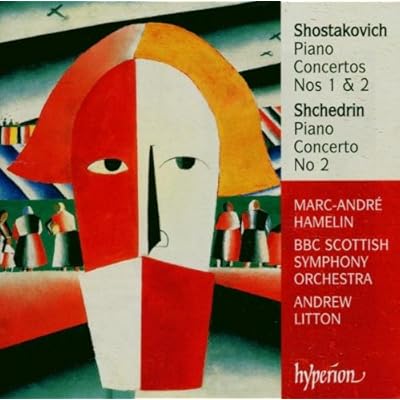
Dmitri Shostakovich - Piano Concertos & Rodion Shchedrin - Piano Concerto No. 2


2004; 10 tracks
Andrew Litton / Glasgow BBC Scottish Symphony Orchestra
Marc-André Hamelin, pianist


Here are some interesting notes about the composer that I agree with (for the most part):

"
Dmitri Shostakovich was the last of the great composers who could be called both traditionalist and modern, and the first of the Russian composers who emerged because of, rather than despite, the Soviet regime. Unlike his compatriots Prokofiev and Stravinsky, both educated in Tsarist Russia, Shostakovich worked entirely under the influence of the communist government, and he struggled all his career with his genuine wish to create art for the state and the state's inability to accept any art it did not understand."

And on the second piano concerto:

"Shostakovich wrote his second Piano Concerto in 1957 as a birthday gift for his 19-year-old son Maxim, a pianist. The piece is full of a light-hearted energy that may owe as much to the composer's relief at the demise of Stalin as to his cheerful wishes for his son.

Both the first and third Allegro movements have a similar structure, each contrasting bright, jaunty tunes against a sort of military tattoo complete with snare drum. The first movement contains fiery lines as well, in an ominous theme of octaves marching up and down the keyboard, and at the broad, dramatic moment when the full orchestra triumphantly roars the main melody.

The second movement, Andante, could easily be mistaken for a composition by Rachmaninoff in its soulful sound. Only strings, piano, and a single horn are heard exchanging tender, lyrical lines, the right hand piano part singing a plangent tune above slow arpeggios in the left. There are no fireworks, only the sort of longing melody one associates with Russian composers of an earlier, more romantic era.

The piano immediately segues into another quick-stepping movement with the second Allegro, this one quite rollicking in tone. There are several sections of rippling scales and arpeggios which, according to Shostakovich, were actually quotes from the well-known finger exercises of Hanon; including them in the concerto, the composer said, was the only way he could force his son to practice them!"

I am a huge fan of Shostakovich's two Piano Concertos, the second of which being perhaps the most marvelous piece of music in the world of sound. The first is much less straightforward than the second, and as such I have found it a little hard to become totally engaged in... it is entirely wonderful, still. I hope I can play these some day :) Aside from the two concertos, this release also features the Piano Concerto No. 2 by none too well known Soviet composer Rodion Konstantinovich Shchedrin. It sounds much like the music of Shostakovich, if not a little less spastic.

Download.

Wednesday, February 2, 2011

Ludovico Einaudi - La Scala Concert


2003; 2 discs, 21 tracks


Ludovico Einaudi is an Italin classical pianist and composer whose electrifying works have been used in numerous film scores and soundtracks. Sadly, I can't find the words to describe this recording, as mesmerizing as it is.

This concert was recorded at La Scala in Milan, Italy, on 3/3/03, and it features the best of Einaudi's solo piano works.

Download.

Wednesday, January 19, 2011

Veljo Tormis - Litany to Thunder


2000; 8 tracks
Marrit Gerretz-Traksmann / Estonian Philharmonic Chamber Choir


For fans of Arvo Pärt and other experimental/contemporary classical artists:

"This startling record begins with two sopranos and a gentle piano sounding for all the world like Enya singing Satie; two tracks later we have a hair-raising chorus and drum hurling curses upon iron (which makes the tools of work and war). It's all the work of Estonian composer
Veljo Tormis, who uses simple, even primitive melodies and ancient folk poetry (perhaps too simple for some listeners, especially those who understand no Finnish or Estonian) with exciting, sometimes atonal but always accessible accompaniment for chorus and/or instruments. The results can be plaintive and calm or vigorous, even feral. The most entertaining piece on the disc is 'The Bishop and the Pagan,' which retells (in a way) the story of St. Henry, who was martyred on a frozen lake in 1158 by an angry peasant with an ax. An alto and two tenors sing a medieval Latin poem in praise of Henry to a very chantlike melody in parallel fifths; meanwhile, baritones and basses pound out (softly at first) an ancient Finnish lyric told from the peasant's point of view. The highlight is when the Henry trio is reduced to a wordless on-pitch howling while the peasant's chant is at its strongest - followed by a surprisingly witty ending. Not coincidentally, the next piece on the record, Litany to Thunder, depicts the sacrifice of an ox to the god of thunder and rain. Frankly, it's terrifying."

Download.

Friday, January 14, 2011

Arthur Honegger - Symphonies 1-5 + Pacific 231


2004; 2 discs
Michel Plasson / Orchestre du Capital du Toulouse


Arthur Honegger was a Swiss composer, born in France, and member of Les Six. His style is similar to that of Milhaud's and Poulenc's, certainly, but there's an odd edge found here in his symphonies, particularly the first. This might have to do with the natural primitism underground artists and those dabbling in Dadaism might have found appealing. Les Six was a group of composers based in France who sought to fight against impressionism and, at times, art itself. This has prompted some to take the composers as Dadaist, or of the same artistic standpoints a Dadaist (Dadaists were avant-garde artists during the first world war who produced art that was... not art). But I cannot really judge this. Honegger's overall brash and manly sound contrasts darkly with the airiness of his contemporaries, I think, which makes me wonder what the purposes of these men truly were. Apparently the six were terribly different in thought, but shared their love of music. It is completely rational to consider these men as simply avant-garde composers who enjoyed cubist and surrealist art, working against the artistic structures of the time to create an entirely new approach to music. Satie and his "furniture music" is one example... "Art that hides art." They were influenced by literary figures such as Jean Cocteau and Ornella Volta, as well as the great artistic minds of the time, most notably Pablo Picasso.

According to his site, Arthur Honegger's music "is characterised by a great sense of architecture which allows him to mix all the different languages and musical techniques of his era. His music serves a humanist concept that is completly in phase with the major questions of the twentieth century." That explains his music perfectly - a great sense of architecture. Honegger loved trains, the suite Pacific 231 being about a train in particular. It's interesting how how many early 20th century composers were so fascinated with trains and the industrial revolution.

I think this quote nicely illustrates the apotheosis of Honegger's musical aesthetic:

"I do not worship the fair, or the music-hall, but chamber music and symphony music for its essence of solemness and austerity. I place such importance in the architecture of music that I would never want to see it sacrificed for reasons of literary or pictorial order. I have a tendency (maybe a little exaggerated) to look for the polyphonic complexity. I am not trying to return to a harmonious simplicity, like some anti-impressionist musicians. On the contrary, I think that we should use the harmonic material created by the school of thought that preceeded us, but in a different way, as a base for figure and rythym."


Disc 1
Disc 2

Sunday, December 19, 2010

Vangelis - Blade Runner OST


2003; 2 discs, 33 tracks


So, yeah. I can't really imagine anything more glorious than this - Greek electronic composer and musician
Vangelis' groundbreaking vision of a work, the accompanying music to Ridley Scott's 1982 film Blade Runner. This is indeed the Esper Edition, a bootleg released in 2003 including some previously unreleased background music and clips from the film. Click here for more information on this edition.

I actually recieved this soundtrack as a Christmas gift 2 years ago, although I only just watched the film for the first time last night. I can't imagine why I put it off for so long. The soundtrack works seamlessly with the film, each scene perfected by the unutterable beauty of Vangelis' futuristic score. Mantric and hypnotic, this soundtrack unites sounds from a variety of cultures and time periods. It is every bit as colorful and magical as the film... synthesizers meet Middle Eastern-influenced jazz, the pattering of rain sweeps over the orphic cascades of modern classical music in a gentle, almost scientific, way. "Rachael's Song" is definitely my favorite song, though.

Disc 1
Disc 2

Tuesday, December 7, 2010

Harold Budd & Brian Eno - Ambient #2 - The Plateaux Of Mirror


1980; 10 tracks


Harold Budd & Brian Eno are two extremely talented musicians, as well as the leaders of modern ambient/neo-classical music. Brian Eno has worked in electronic music for the better half of the 20th century, while Harold Budd has worked as a consistent member of the shoegaze/dreampop band Cocteau Twins. The Plateaux of Mirror is a calming instrumental album full of soft, synthy piano melodies.

Download.

Thursday, November 18, 2010

Valentin Silvestrov - Requiem for Larissa


2004; 7 tracks
Vladimir Sirenko / National Symphony Orchestra of Ukraine


"
Silvestrov's Requiem for Larissa is a poignant tribute to the memory of his late wife, a bitterly-wrought mourning piece that transcends his individual grief to strike a universal chord. Its seven movements are played without pause, utilizing a large chorus and orchestra, piano, and a synthesizer. Its text is the traditional, though fragmented, Latin Requiem, along with an excerpt from a grim poem, 'The Dream,' by the Ukranian poet Taras Shevchenko.

This last constitutes the haunting fourth movement, the sung words, a 'farewell to earth,' set to a slow pianissimo folklike melody that stays in the memory. The next movement, the Agnus Dei, includes extended Mozartian solos for violin, its postlude a moving depiction of unearthly peace. The final two movements are a reprised variation of what has come before, from the hieratic opening drenched in sorrow to a Tuba mirum that rages against the dying of the light. The last sounds we hear are the gentle rustlings of the wind, as Nature washes away grief. Silvestrov's sound world is unique, as is this modern masterpiece" - someone

"While Silvestrov's inspiration is the Latin mass for the dead so widely set in the classical tradition, this is no typical requiem. There's a 'Requiem eternam' and a 'Lacrimosa', but only a few isolated words are selected from the traditional text. There is no 'Dies irae', and no wonder, as who wants to think about one's departed loved one being judged? The work is generally symmetrical. The opening and closing portions of the work are typical of Silvestrov's late orchestral music, with that special lush yet grim lake of sound. At one moment in each of these two framing portions, however, we are treated to a beautiful bit where strings playing harmonics dialogue with flutes.

The middle section, however, will be for many listeners the emotional heart of the world. Here Silvestrov leaves behind the Latin mass and includes a setting of Taras Shevchenko's poem saying goodbye to the world." - Christopher Culver

Requiem for Larissa, for mixed choir & chorus, is a genuinely moving piece of modern classical music... I cannot express how beautiful this is.

Download.

Saturday, September 18, 2010

Alfred Schnittke - Complete Piano Sonatas

Wednesday, September 15, 2010

Samuel Barber - Piano Music

Thursday, August 12, 2010

John Tavener - Piano Music + others

Piano Music


2008
Ralph van Raat, piano


The Eastern mysticism that Tavener has made his own - he has been a member of the Russian Orthodox church and imbibed its colours into his music - is present in most of these works. He does a good job of using the instrument's more limited resources to achieve similar effects to those in his larger orchestral and choral works. Yet the earlier works tread the line between consonance and dissonance in a way I find quite irritating. Ypakoë, for example, has a simple, profoundly spiritual melody which is allowed to sing out towards the middle and end of the piece. To get there, however, we have to put up with all manner of meanderings that seemed quite purposeless to me. Palin, his first piano work, features many instances when one key is sounded frequently and continuously for about 10 seconds at a time. It's meant to evoke approaching thunder, but it just sounds tedious.

The lighter works on this disc, tracks 4 and 6, are dedicated to the memory of Tavener's cats, and they see a return to traditional, triadic harmonies. These portraits are affectionate and warm: we even have glissandi to represent the pets running over the keys. Mandoodles contains jazz rhythms and reference to a Chopin Prelude, and In Memory of Two Cats is simple, bell-like and appealing. As with Ypakoë, an austerely beautiful melody is allowed space to sound. It is at moments like these that the disc is at its best and these get their fullest flowering in Pratirūpa, the longest and most recent work here.

All this suggests a sense of development in Tavener's style, from overt modernism through to a more sophisticated use of harmonies in his later works. The disc - the only one of this music? - is a welcome step in plugging this gap and any of the composer's fans who want to experience his broader range shouldn't hesitate. Performances are highly committed and the sound is up to the usual Naxos high standard.

Download.


The Protecting Veil


1992
Steven Isserlis, Cello; Gennady Rozhdestevensky / London Symphony Orchestra


The Protecting Veil is a musical composition for cello and strings by British composer John Tavener. Completed in 1988, the work was at first a suggestion from cellist Steven Isserlis and subsequently commissioned by the BBC for the 1989 Proms season. The inspiration of the piece comes from the Orthodox feast of the Protecting Veil of the Mother of God, which commemorates the the apparition of Mary the Theotokos in the early 10th century at the Blachernae Palace church at Vlacherni, Constantinople.

This CD also contains Tavener's Thrinos suite for string, and Benjamin Britten's Third Suite for Cello.

Download.


The Best of John Tavener


2004; 11 tracks


Here is a collection of Tavener's most beautiful music. This album solidifies my admiration for Tavener - he really is one of the most amazing contemporary classical composers I've ever heard. His idea of "holy minimalism" in music is fascinating as well.

Download.

Friday, June 25, 2010

George Crumb - Vox Balaenae


George Crumb is an American avant-garde composer, born in 1929. His music is among some of the most unique and not retarded avant-garde classical music I've heard. It's extremely atmospheric - and interactive. I'm sure the performers had fun playing these pieces. The music of George Crumb is more difficult to play and decipher than it is to listen to, I think. The instrumentation is a tiny bit complex - many outside tools and instruments aside from the basic piano and string and wood instruments are used in these pieces to create Crumb's desired effect. For example, in Vox Balaenae, Crumb has instructed the piano performer, at certain parts, to pluck at certain strings in the piano while the lid is open, to place a chain on top of the strings while playing so as to create a metallic effect as the hammers hit the strings, as well as to play a key repeatedly while moving the flat head of a chisel up and down a string so as to increase and decrease the pitch of the key, making it sound much like a synthesizer. There are many sounds on this album that I had no idea these basic instruments could make, and the range of effects is purely magical.

This might be one of my new favorite classical albums for sure, (though I am enjoying Camille's 3rd Symphony quite a lot). It is full of life and yet so mystic you feel as though you are passing through a small wooden door into a new, brighter world. Just listen and let yourself be taken away, perhaps for a moment - perhaps for a lifetime, by George Crumb.


2006; 24 tracks

Download.


1-11. Eleven Echoes Of Autumn (Echos 1) for violin, alto flute, clarinet and piano.
12-15. Four Nocturnes (Night Music II) for violin and piano.
16-23. Vox Balaenae (Voice of the Whales) for electric flute, cello and amplified piano.
24. Dream Sequence (Images II) for violin, piano, percussion and glass harmonica.

Performed by the Ensemble Für Neue Musik Zürich.


Vast, lonely, timeless...

Popular Posts